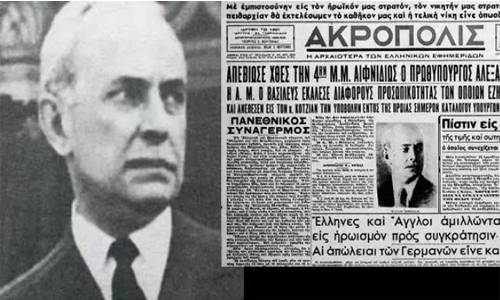
“Yesterday, at the 4th hour of the afternoon, the President of the Government, Alexandros Koryzis, passed away suddenly. (…) His death occurred suddenly, immediately after the noon cabinet meeting, and as was to be expected, the sad news, having immediately run through the capital, plunged public opinion into grief, which surrounded the late Koryzis with such esteem, especially for his brilliant management of the country’s fortunes during the last trimester.” — Newspaper “To Eleftheron Vima”, April 19, 1941.
At noon on April 18, 1941, Good Friday, Alexandros Koryzis, the appointed Prime Minister of Greece, meets King George II at the “Grande Bretagne” Hotel (then the seat of the Government). A short while later, he goes to his residence on Queen Sophia Avenue, locks himself in his study, and commits suicide with his service revolver.
On April 19, 1941, all Athenian newspapers published the news of the “sudden death” of Prime Minister Koryzis with banner headlines. Of suicide, there is no mention. The country is passing through critical hours. The Greco-Italian War on one side, the imminent German invasion on the other. The official admission of the Prime Minister’s suicide would sow suspicions and create panic at a critical phase, with dire consequences for the fate of the country.
Who was Alexandros Koryzis?
Alexandros Koryzis was born on the island of Poros in 1885. He was the son of G. Koryzis, who had served as a Member of Parliament for Troizinia and Mayor of Poros, the grandson of S. Koryzis, also an MP for Troizinia, and the great-grandson of the 1821 revolutionary fighter G. Koryzis. He was taught the liberal arts in Poros and Athens. From 1901 to 1905, he attended the Law School of the University of Athens, while he had already been hired (1903) at the National Bank of Greece. He participated in the Balkan Wars, where he distinguished himself.
He continued his career at the National Bank, and in 1919-1920 he served as a financial advisor to the High Commissioner of Smyrna, Aristidis Stergiadis. In the capital of Ionia, it was he who founded and organized the branch of the National Bank. In 1925, he contributed to the creation of the Autonomous Currant Organization (ASO), of which he served as President of the Board (1925 – 1928).
He also contributed to the founding of the Agricultural Bank and was the first President of its Board (1929). In 1928, he was appointed Deputy Governor of the National Bank, and by government order, he submitted a draft law for the establishment of a Supreme Economic Council (1929). He served as Minister of Finance in the short-lived Othonaios government (March 7 – 10, 1933) and as Minister of State Hygiene and Welfare (August 5, 1936 – July 12, 1939) under Prime Minister Ioannis Metaxas. After the death of Ioannis Drosopoulos (August 9, 1939), he assumed the position of Governor of the National Bank.
Historical Context
In January 1941, Metaxas did not want the British on Greek soil. He believed that such a move would be a provocation to the Germans, with whom he was discussing a proposal to retain the Albanian conquests in exchange for neutrality.
“With Palai ret – the ambassador – I explained myself clearly and sincerely. We will provoke a German attack. Is it worth it?” he writes in his diary in 1941. “For the time being, I hope to avoid Thessaloniki and consequently German intervention.”
On January 17, 1941, Metaxas felt a slight indisposition. It was a peritonsillar abscess, but “despite its timely opening and the appropriate post-operative treatment, it subsequently presented toxemic phenomena and complications, such as gastrointestinal hemorrhage and uremia, and he died today, 6 a.m., on January 29, 1941.”
The newspaper “Vradyni” on January 30, 1941, would speak of a mysterious English doctor who gave him an injection. The mysterious death of the then Security Commander Paxinos, who was later found murdered, intensifies the mystery.
A. Koryzis as Prime Minister
The royal preferential choice of Koryzis was due to a corresponding recommendation by Ioannis Diakos and Konstantinos Maniadakis to King George II. It is not exactly understood what this choice was based on, nor how much the fact that he maintained a close personal connection for years with the notorious Dimitrios-David Balfour* influenced such a development, but what is certain is that at that hour it was readily accepted by British agents.
No other candidacies were examined, nor was there any hesitation. He was sworn in immediately and assumed the prime ministerial duties, simultaneously taking on the additional ministerial portfolios that his deceased predecessor held: Foreign Affairs, Education, Military, Naval, and Aviation. The composition of the government remained exactly the same, and the struggle at the Front continued with the same determination.

Only one change was made, entirely invisible and imperceptible to the wider public opinion. Immediately after the prime ministerial change, the Greek government accepted London’s request for the presence of limited British forces in Northern Greece. That which Metaxas had vehemently refused in the last days of his life, Koryzis accepted without a second word.
The verbal note of the deceased prime minister to the British government was sent on January 18, 1941, and bore the last signature he put in his life. After this note was delivered, Ioannis Metaxas, as if by coincidence, fell into a relentless serious illness and after eleven days passed away. On this “motive” base those who claim that he was murdered.
But his successor, who until those historic hours had shown his talent as a capable banker, did not react in the first days of his premiership as his predecessor did, who had proven talents as a general and diplomat. He realized the problem a few weeks later and after having accepted the specific British “help.” The now looming German attack against us pushed him into new thoughts, to the point where the British in Athens were annoyed.
It is characteristic that a young Englishwoman, named Cynthia Overton Preston, who had settled in Athens in 1938 at the age of just twenty-five and worked simply as an English teacher, but obviously moved in the background and had influence, appeared on March 7, 1941, to Prince Peter (who then held the critical position of head of the Liaison Office with the British) and asked him to intervene with his cousin, King George II, to… dismiss Prime Minister Koryzis! She herself, until her death in 2010, never gave any explanation, although the incident had already been publicized in the war diary of Prince Peter. Therefore, already a month or more before the German ultimatum was delivered, Prime Minister Koryzis was not to the British liking.
Generally, foreigners had a positive impression of Koryzis, as they characterized him as reputable and an experienced economist, a public man and not a politician, and conscientious, a strong self-made man of great dignity who despised party bosses and their machinations. Conversely, the British ambassador in Athens, Michael Palairet, considered Koryzis a weak character and a person without personality.
Koryzis’s statement when he assumed the premiership is considered historic, as he accepted a Golgotha that led to his sacrifice in every way.
Despite the many problems Koryzis had to face internally, he is largely credited with repelling the Italian spring counter-offensive in Northern Epirus (March 1941). Of course, the credit must go primarily to the heroic Greek soldiers who did not break.
As Mussolini failed miserably to defeat the Greek army, it was almost certain that the Germans would attack Greece. Thus, Koryzis found himself discussing with the British the way to react to a possible German invasion of Greece.
As Nikos Giannopoulos writes in his book “THE GERMAN INVASION OF GREECE. THE FORGOTTEN NO,” “between the Greek and British leaders, there were different estimates, because they faced the problem from a different perspective, resulting in serious disagreements during the negotiations for dealing with the impending German attack against Greece,” and then he writes: “Greek and British staffs had committed tragic tactical errors, which the experienced German generals were not going to leave unexploited.”
At 5:15 a.m. (5:20 a.m. according to the Germans) on April 6, 1941, the first German attack against the Greek outposts on Mount Beles was launched. 15 – 30 minutes later (there is disagreement among sources) the German ambassador to Greece, Prince Viktor zu Erbach, visited A. Koryzis at his home and handed him a note, i.e., a diplomatic demarche (not an ultimatum or an official declaration of war), obviously to avoid a second “No.”
Koryzis read it hastily, and Erbach said to him: “I must inform Your Excellency that at this moment, on behalf of the German government, a note is being delivered to the Greek ambassador in Berlin. Through this announcement, we inform you that German troops will enter Greek soil this morning following the arrival of British military forces in Greece.”
Koryzis rose from his armchair and replied: “Please convey to your Government that Greece, defending its paternal soil, will oppose with arms any attempt by German troops to invade it.”
The German ambassador was accompanied by the military attaché, Colonel von Klem Hockenburg, who spoke Greek very well, having learned it in Smyrna, where he lived and grew up with Greek children. He even recited with ease verses from Homer’s “Iliad” and “Odyssey”! Ambassador von Erbach was a Philhellene. After the occupation of Athens by the Germans, he expressed his displeasure, and Berlin immediately placed him on standby!
On the same day, he issued a proclamation calling on the army and the people to resist and fight. This decision of his has been recorded as the second NO, a few months after that of Metaxas to the Italian ultimatum.
This was the second “No” of the Greeks to the Axis forces, which has not received the same place in history as the first “No,” of Ioannis Metaxas. Of course, neither Metaxas nor Koryzis said (in one word) “No,” yet this is how they passed into history, and as “No” they will remain forever in it…
The German Advance
As we mentioned, the Greek forces continued to fight successfully against the Italians in Northern Epirus, while the Germans met brave resistance at the forts of the Metaxas Line (Macedonia-Thrace), which surprised them particularly when they made comparisons with the resistance they encountered on the Western Front. Despite their losses, however, their superiority both in manpower and armament helped them break the resistance of the heroic Greeks.
However, the burden Koryzis had to bear on his shoulders after the German advance was enormous. There were conflicting perceptions, nightmarish data, appeals from the front, and, above all, British pressure. The English feared that the resistance of the Greek army in Albania might collapse, thus hindering the withdrawal of their 60,000 troops from Greece.
At the same time, there was the danger that the victors of the Greco-Italian war would be taken prisoner by the Italians whom they had routed on the battlefields. It was decided, in a first phase, to move the royal family and the government to Crete and then, if deemed necessary, to the Middle East.
The Critical and Fatal Meeting
As Iakovos Chondromatidis writes: “What is certain is that Koryzis proved to be a more consistent Anglophile than his predecessor and immediately accepted the ‘symbolic’ British help, although he knew that the installation of British military units in Northern Greece would cause an immediate German reaction.”
It should be noted that the Germans, on the morning of April 9, 1941, had occupied Thessaloniki and continued their advance into Southern Greece.
On April 18, 1941, an extraordinary meeting of the cabinet was held at the “Grande Bretagne” hotel. George, according to I. Chondromatidis, quickly realized that Koryzis was not the suitable and decisive man needed. Even Metaxas’s close associates, Maniadakis and Diakos, who had initially agreed to entrust the premiership to Koryzis, changed their minds.
After the end of the cabinet meeting, during which George scolded Papagos and then Koryzis, the King, Koryzis, Maniadakis, Deputy Minister of Military Papadimas, and the Garrison Commander Kavrakos remained to discuss measures to maintain public order that needed to be taken in Athens. As soon as this meeting ended, George and Koryzis remained alone for 10 minutes. What exactly was said in this meeting remains unknown.
What is certain, however, is that George, pressured also by British Ambassador Palairet, conveyed the British criticisms to Koryzis, while he appears to have blamed him for the collapse of the front and the leaves given to soldiers, by order of Deputy Minister of Military Papadimas. Probably the Deputy Minister of Press, Theologos Nikoloudis, also spoke ill of Koryzis to the King. Nikoloudis disliked Koryzis, whom he had even characterized as “mentally ill”!
George reprimanded Koryzis, speaking to him very intensely. Voices were heard in the corridors of the “Grande Bretagne”: “The certain thing, Mr. President, is that control of the situation escaped from your hands,” said George, as reported by T. Kontogiannidis and I. Chondromatidis.
The sensitive Koryzis was shaken and replied: “Your Majesty, my whole life is a series of honest acts. I was honest, I am honest, and I will die an honest man.” At the same time, he asked George to replace him with someone else, perhaps someone more dynamic, maybe a military man, and continued: “Your Majesty, I am going to my house to rest for a while, because I am tired. I hope to see you soon”… Koryzis, moved, kissed the King’s right hand and departed gloomy…
Leaving the King’s office, he met Minister K. Kotzias, who, seeing him downcast, asked him what was happening. “Nothing,” Koryzis replied.
At the entrance of the hotel, he met Prince Peter, who writes in his “Memoirs” (newspaper “Acropolis,” February 1978): “We lightly pushed each other, and I managed to cast a quick glance at his drawn and dejected face, through the glass that separated us. I thought how tired he looked and said to myself that it was not strange, since he was loaded with so many responsibilities at this phase.”
The Suicide (?) of A. Koryzis
A little later, Koryzis arrived at his home, “pale and crushed,” as his wife said later, causing lively anxiety both in her and in their children. He contented himself only with saying that he absolutely needed to be left alone, not to be disturbed by anyone, and that he would go to his private office because he wanted to write a letter.
In the meantime, George became worried seeing Koryzis leave in a wretched state and asked K. Kotzias to urgently send Ioannis Diakos to Koryzis’s house and notify him to return to the “Grande Bretagne,” because he needs him.
It should be noted here that George did not send Prince Paul to Koryzis’s house, as incorrectly stated in Wikipedia and elsewhere. We asked Dr. Ioannis Papapfloratos, an excellent connoisseur (also) of that specific period of Greek history, who told us that no source mentions that Paul went to Koryzis’s house. The one who went was Ioannis Diakos. But who was Ioannis Diakos?
Enigmatic and dark personality, a journalist who published the newspaper “Efimeris ton Ellinon,” private secretary and confidant of I. Metaxas who participated in all cabinet meetings. He clashed fiercely with the ministers of the Metaxas government, Theodoros Skylakakis (grandfather of the current minister) and Alexandros Papahelas (grandfather of Alexis Papahelas), who resigned from the government and were exiled…
Diakos arrived at Koryzis’s house. As the elevator was broken, he ran up the stairs. Let’s see what he told K. Kotzias:
“I knocked on the door, and Mrs. Koryzis opened it immediately. I asked her breathlessly and with anxiety where the president is. ‘In his room,’ she replied, agitated and with worry. Let’s go there immediately, I fear some irreparable harm! I followed her running to the prime minister’s room. The door was closed. With our first knock and the calling of his name, we heard a gunshot and were stunned. Immediately after, a second gunshot! We broke down the door, while we hoped not to face the sight we feared. Alexandros Koryzis was dead, on his bed, with the icon of the Virgin Mary on his chest. From the autopsy performed, we found that Koryzis had two penetrating wounds to the heart. This fact was exploited, rightly so, by German propaganda, which spoke of the ‘murder of the Greek prime minister by British secret services.’ Who shoots themselves twice in the heart anyway?”
When he returned to the “Grande Bretagne” with the sad news, everyone was shocked. More than anyone else, George, who had pangs of conscience because he had reprimanded Koryzis.
“I didn’t say anything to offend him! Suddenly he kissed my hand, got up to leave, and told me he was going home for his affairs. It is tragic, it is unbelievable! I didn’t say anything to offend him,” said the King.
It was subsequently decided not to announce that Koryzis had committed suicide, so as not to shake the morale of the soldiers fighting. Thus, it was announced that “Prime Minister Alex. Koryzis passed away suddenly”…
The “Suicide” of Koryzis and the Kotzias Government
From 4:15 p.m. on April 18, 1941, when A. Koryzis was found dead, until today, there is no clear answer as to whether he committed suicide or was murdered. Dr. Ioannis Papapfloratos characterized the death of Koryzis as a strange and dark affair.
We turned to a doctor, with excellent knowledge of forensic medicine (studies in the USA, Germany, collaboration with Greek forensic pathologists, etc.), who told us that Koryzis was already dead from the first shot.
Even if this had not happened, it is impossible for the right-handed Koryzis to find the strength to shoot himself a second time with his left hand. We thank the doctor warmly and respect his wish not to mention his name.
Iakovos Chondromatidis is extremely revealing… Let’s see what he writes.
“According, then, to the eyewitnesses of Koryzis’s ‘suicide’ (I. Diakos and Koryzis), the prime minister was found dead holding a revolver in his left hand and having an icon of the Virgin Mary on his chest.
How, however, was it possible for a right-handed man to use his left hand to shoot himself, remains unanswered for seven (note: eight today) decades.
Obviously, his murderer, amidst the turmoil of those moments, omitted this important detail and, committing an error, placed the weapon in Koryzis’s left hand…
The fact also that K. Kotzias states that the gunshots heard ‘were two’ reasonably raises the question of how the sick and elderly banker could shoot himself twice.
Regarding the discretion of the widow Koryzis, her family was rewarded for its devotion to the Crown. After the war, her daughter, Frosso Koryzis, was hired at the Palace.
Regarding the causes that provoked the murder of Al. Koryzis, K. Kotzias states that the only people who knew the truth were George, K. Maniadakis, and the secret counselor I. Diakos (see K. Kotzias: Greece, the War, and its Glory, 3rd edition, Athens 1947, p. 405).
Also noteworthy is the fact that shortly after the murder of Koryzis, George hurried to meet first his two secret counselors, I. Diakos and K. Maniadakis. Presumably, the people who would undertake the formation of the new government had to be of the absolute trust of the British ambassador.”
A Novelistic Scenario
Thus, even today in books or studies on that period, his death remains a gray event with uncertain justifications. Some say he committed suicide so as not to be the one to surrender the country to the Germans, others because he was branded a thrower of the shield when he suggested capitulation. Other sources, better informed, speak of suicide from sensitivity when the King accused him of frivolous divulgence of state secrets. However, the exact facts were never recorded until now.
The first version is that on Good Friday of 1941, as the Germans approached, Koryzis – as a true hero so as not to be the one to surrender the country – committed suicide.
Many decades later, an old politician, who does not want to be revealed, a close friend of the family, would circulate another version of the events. Koryzis did indeed commit suicide, but because he had a relationship with a woman of loose morals – with whom he might even have had a child – when the King called him. But the issue was not that. It was that this woman maintained a parallel relationship with the driver of the German embassy in Athens, that is, a spy who, at the time of war, could have indirect information from the Prime Minister himself!
Koryzis had organized with the King and Churchill a defense plan with a second front – a bluff at Thermopylae to mislead the Germans. The German [driver] visited her that afternoon and found her preparing to leave Athens. And so he realized that the Prime Minister would leave too and that the second front was a bluff.
He goes to the Embassy, conveys the news, and at the same time, Berlin learns the secret plans of Greece. At this point, developments take a sudden turn. British counter-intelligence maintained at least one informant in the German High Command, either among the generals or among the transmission staff. That person simultaneously conveyed the information to London, that is, to Churchill.
Taken by surprise, Churchill telephones George and announces to him that whatever they had planned has gone to the devil. The secret leaked, Berlin knows. We won’t make it in time to regroup. With phlegmatic irony, he tells him that he had no reason to betray the secret, while declaring that he does not question his integrity and urges him to take measures.
It is April 18, 1941. The King calls Koryzis to his office and repeats what was said with Churchill. “I expect you to do your duty.”
A one-way street. Koryzis returned home and committed suicide. Turmoil, rumors, dissemination followed. It became a buzz that Koryzis committed suicide. But the matter had to be covered up at all costs; otherwise, it risked taking unwanted dimensions.
To stop the “malicious rumors,” the King and the government rushed to announce their sorrow for the sudden death of the Prime Minister. They also announced that those who spread unsubstantiated information about suicide would be referred to court-martials. Although a suicide, Koryzis was buried with a religious ceremony, even though the strict canons of the time forbade it. An autopsy for the exact causes of his “sudden” death was never performed.
Certainly, in that historical conjuncture, the admission of suicide for any reason would lead to uncertain conclusions and would dynamite the already tense situation of the nation with serious consequences. On the other hand, the danger of the truth being revealed, the frivolous mistake with the disastrous consequences, would create a scandal that would stain the reputation of Alexandros Koryzis.
Although a “suicide,” Koryzis was buried with a religious ceremony, even though the strict canons of the time forbade it. According to the description of Dionysios A. Kokkinos, as published in his book “The History of Modern Greece”: “Towards noon on Great Saturday, during the funeral, while the funeral procession was on its way from the Cathedral to the cemetery, swarms of German planes bombed the installations in the Athens area and the airfields. The Greek and British anti-aircraft guns fired at the planes, and the explosions of the dogfight mingled with the sounds of the honorary gunshots fired before the tomb of the deceased. Koryzis was buried like a distinguished war casualty during a literally raging battle…”.

On the same day, April 19, 1941 (Great Saturday), a meeting was held again at Tatoi, with the Commander-in-Chief of the British forces, Archibald Wavell, who had come from the Middle East, and Lieutenant General Alex. Mazarakis, with the aim of replacing Koryzis. On April 20, a capitulation is signed by the commander of the Army of Western Macedonia, General Tsolakoglou. On April 21, Emmanouil Tsouderos forms a government which, the next day, April 22, leaves for Crete together with the King!
The Truth and the Lie
History takes a different turn, now. It could be a movie script, but also a piece of modern Greek History. But it could also be the truth. Which always escapes us. Or concerns no one, especially if it spoils the heroism and the image we have of the heroes of our indomitable nation.
Be that as it may, a few days later, the Occupation began. A special German mission under Künsberg arrived in Athens, which, among other things, sought evidence and information on how exactly the death of Koryzis occurred.
They also visited his family, at the same house at 51 Queen Sophia Avenue, where he had answered “NO” to the German ambassador Erbach in the morning hours of April 6, 1941, and his relatives refused to cooperate. Exactly the same happened with the family of Metaxas, whom they also visited.

Anyway, exactly fifteen days earlier, another prime minister had committed suicide in Hungary, Pál Teleki, who, however, was of 50% Greek descent. But he left a handwritten letter for the cause of his gesture, which was faintly related to Greece: He disagreed with the passage of German troops through Hungarian soil, which were heading against Yugoslav soil, a move that (as far as we are concerned) resulted in the rapid occupation of Thessaloniki!
Both these deaths, during a titanic struggle that Greece was waging against the Axis forces, however strange they may have been, were never investigated as they should have been. Not even forensic reports were drawn up…
Lord David Balfour [David Balfour], English nobleman and aristocrat, descendant and member of a family of Jewish origin, from which came prime ministers, ministers, admirals, and generals of Great Britain, Orthodox priest-monk of the Russian Church known in Greece by the name Father-Dimitrios, who appears as an agent of the British Secret Services with the rank of senior officer who played a significant role in political events in Greece, some years before and after World War II, while slandered by a few from the mechanisms of the Communist Party of Greece on the occasion of his extensive anti-communist action, later a diplomat and the third most powerful man of the British triumvirate in post-war Greece, after General Scobie and Ambassador Reginal Leeper, but also a Doctor (PhD) of Theology, was born on January 20, 1903, in England, where he died on October 11, 1989.
Sources:
https://www.protothema.gr/stories/article/1070094/alexandros-koruzis-autoktonise-i-dolofonithike-o-prothupourgos-tou-deuterou-ohi/ — Michalis Stoukas
https://www.athensvoice.gr/52433_i-aytoktonia-toy-prothypoyrgoy-koryzi — Eugenia Migdou
https://www.anoixtoparathyro.gr/%CF%84%CE%BF-%CE%B4%CE%B5%CF%8D%CF%84%CE%B5%CF%81%CE%BF-%CF%8C%CF%87%CE%B9-%CF%80%CE%BF%CE%B9%CE%BF%CF%82-
%CF%83%CE%BA%CF%8C%CF%84%CF%89%CF%83%CE%B5-%CF%84%CE%BF%CE%BD-%CE%BA%CE%BF%CF%81%CF%85%CE%B6/ — By Nikos Lakopoulos
http://aera2012.blogspot.com/2020/04/blog-post.html
http://aera2012.blogspot.com/2020/04/blog-post.html — By Dimosthenis Koukounas
https://vironasipolimas.blogspot.com/2017/04/18-1941.html
https://el.metapedia.org/wiki/%CE%9D%CF%84%CE%AD%CE%B9%CE%B2%CE%B9%CE%BD%CF%84_%CE%9C%CF%80%CE%AC%CE%BB%CF%86%CE%BF%CF%85%CF%81