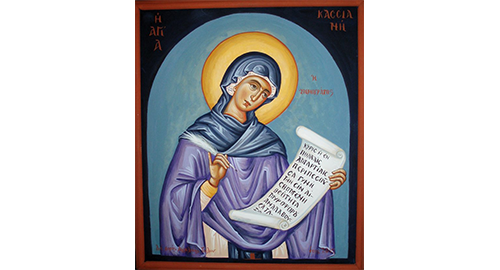
Many and various are the names by which Kassiani is referred to in the manuscripts. Kassiani and Kassia, Kasia and Kassia, Eikasia and Ikasia. In the Byzantine chroniclers, she is referred to as Eikasia (George the Monk or Hamartolos and Symeon the Magister and Logothete), as Ikasia (Leo the Grammarian), and as Kasia (Michael Glykas).
She was born during the period 805-819 AD in Constantinople and was the offspring of a feudal family. Her father, in fact, held a significant position at the Court of the Palace of Blachernae. The year of her birth and death and her place of origin are unknown.
“O woman, would that you were silent!”
The historical event, as described by the Byzantine chroniclers Symeon the Magister, John Zonaras, George the Monk or Hamartolos, and Leo the Grammarian, states that the mother of Emperor Theophilos, or according to others his stepmother Euphrosyne (829-842), following the family tradition for the election of a bride, invited the most beautiful and distinguished daughters of the empire to the Court. Twelve “most beautiful maidens” responded to the invitation and arrived at the Palace. After their reception, Euphrosyne gave him [Theophilos] a golden apple to offer to the one who pleased him the most. The ceremony is said to have taken place during the period 821-830 AD. Theophilos was impressed by Kassiani’s beauty and wanted to test her cleverness and readiness before giving her the golden apple. Therefore, he said to her: “Ως άρα διά γυναικός ερρύη τα φαύλα!” (“Truly, through a woman did the base things flow forth!”), that is, “from one woman came the evils into the world,” referring to the sin and misfortunes that resulted from Eve.
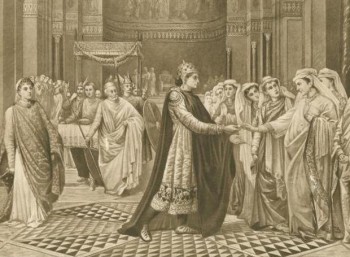
Kassiani then answered aptly and most wittily: “Αλλά και διά γυναικός πηγάζει τα κρείττονα” (“But also through a woman spring forth the better things”), referring to the hope of salvation through the birth of Christ from the Virgin Mary. The quick-tempered Theophilos was then dominated by the “lover” [his ego]. He would not take a wife wiser than himself. Therefore, he said to her: “Ω γύναι, είθε να εσίγας!” (“O woman, would that you were silent!”) and proceeded towards the sister of Bardas, Theodora, who appeared taller than Kassiani and more stout, but was also modest and beautiful.
Since then, Kassiani built a monastery and lived her dedicated life as a nun. The “Patria of Constantinople” also testify that she built a monastery, and M. Gedeon (Byzantine Calendar, Constantinople 1899, p. 218) places it “in the Hypsomatheia of Constantinople.”
The Visit of Theophilos to Kassiani’s Cell
According to tradition, Emperor Theophilos, continuing to be in love with her, desired to see her one last time before he died, so he went to the monastery where she was staying. Kassiani was alone in her cell writing her troparion when she realized the arrival of the imperial entourage. She still loved him, but she had now dedicated her life to God, so she hid, not wishing to let her old passion overcome her monastic zeal.
However, she left the half-finished hymn upon a table. Theophilos discovered her cell and entered it all alone. He looked for her, but in vain. She was watching him from inside a wardrobe in which she had hidden. Theophilos was distressed, wept, and repented that for a moment of pride he had lost such a beautiful and intelligent woman.
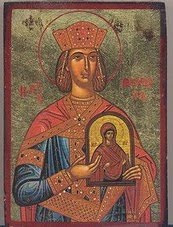
Subsequently, he found Kassiani’s manuscripts on the table and read them. As soon as he finished reading, he sat down and added one verse to the hymn. According to tradition, this verse was: “ὧν ἐν τῷ παραδείσῳ Εὔα τὸ δειλινόν, κρότον τοῖς ὠσὶν ἠχηθεῖσα, τῷ φόβῳ ἐκρύβη” (“Whose sound, when Eve heard it in Paradise at sunset, she hid in fear”).
Upon leaving, Theophilos spotted Kassiani hiding in the wardrobe but did not speak to her, respecting her wish. Kassiani came out of her hiding place after the Emperor’s departure, read his addition, kept the verse, and included it in the troparion, and then completed the hymn.
The troparion was inspired by the adulterous woman whom Jesus saved from stoning, saying the phrase: “He that is without sin among you, let him first cast a stone,” and it is chanted on Holy Tuesday.
The Troparion of Kassiani
“Lord, the woman who had fallen into many sins, perceiving Your divinity, took upon herself the rank of myrrh-bearer, and lamenting, brings myrrh to You before Your burial.
Woe is me! she says, for night is become for me, the sting of licentiousness, a gloomy and moonless love of sin.
Receive the fountains of my tears, You who draw down the water of the sea into clouds; bow down to the sighs of my heart, You who bowed the heavens by Your ineffable condescension.
I shall kiss Your pure feet and wipe them with the hair of my head; those feet whose sound Eve heard in Paradise at sunset and hid in fear.
Who can trace the multitude of my sins and the abyss of Your judgments, O Savior of my soul? Do not disregard Your handmaiden, You who have mercy without measure.”
Translation into Demotic Greek by Kostis Palamas
“Lord, the woman who fell into so many sins, when she heard, when she felt Your divine Grace, like a myrrh-bearer, drowned in tears, brings You myrrh before Your burial, and alas, she sighs, weeps, and mourns; a great moonless and dark night beats me, a night of sin that burns and stings desires of licentiousness.
Accept, O Christ, the fiery tears that I shed for You, You who draw the water of the sea into the clouds. Turn Your compassion to my sighings, You who bowed the heavens in Your divine birth.
Allow me to kiss Your holy feet and to wipe them with my blonde hair. The feet, which when Eve heard their sound at dusk in Eden, hid out of fear. Who can measure my many sins and Your deep judgment, O Christ my Savior, soul-saver?
Do not leave me, Your humble servant, desolate, You who, as God, have infinite [mercy].”
Sources:
http://flashnews.gr/post/69245/i-istoria-tis-amartolis-kasianis
http://www.patris.gr/articles/107507?PHPSESSID=#.WOy64oiGPcs